Thick Earth, Fluent Light: Wang Shaoqiang’s Investigations and Transfigurations
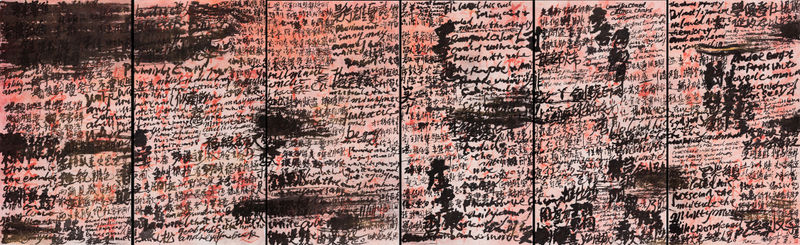
INKstudio is honored to present “Thick Earth, Fluent Light: Wang Shaoqiang’s Investigations and Transfigurations”, a solo exhibition by artist Wang Shaoqiang. In the latest phase of his contemporary shuxie practice, Wang draws extensively from Eastern and Western philosophy, ecological thought, and historical textual resources. Referencing such Eastern classics as the Yijing and the Zhuangzi, along with important intellectual texts from different civilizational traditions, and forward-thinkingly incorporating artificial intelligence into his research process, he has developed a form of language-based conceptual art oriented toward a global context. Integrating the embodied discipline of traditional Chinese calligraphy with the critical perspective of contemporary language-based conceptual art, he brings about contemporary expression and visual reconfiguration of cross-cultural intellectual materials through the cross-translation, transcription, and reinscription of multilingual texts.
The exhibition “Thick Earth, Fluent Light: Wang Shaoqiang’s Investigations and Transfigurations” unfolds through five units, presenting the conceptual writing practice Wang Shaoqiang has developed in recent years and the cross-cultural hermeneutic path it traces. Unit One begins with A Thousand Characters and works developed around the Explanation of the Diagram of the Supreme Ultimate, marking a significant turn in his writing practice and bringing cross-cultural lines of thought into a shared visual field. Unit Two further examines the relationship between language, world, and understanding, opening up the question of how interpretation becomes possible through the juxtaposition and translation of multilingual texts. Unit Three extends this inquiry into a deeper reflection on ecology, nature, and processes of generation, bringing intellectual resources from different civilizational traditions into the research horizon of contemporary writing. Unit Four turns to the deeper resonances between modern and contemporary artistic concepts and Eastern intellectual traditions, offering new reflections on language, action, silence, everyday life, and existence. Unit Five returns to Wang Shaoqiang’s original path in landscape practice and continues to develop landscape as a form of visual hermeneutic practice. In this section, the artist further reflects on ways of understanding “nature”, reactiv ating the intellectual tension of landscape in a contemporary context through the organization of brushwork, structure, and spatial relations. Meanwhile, this unit also draws elements from the artist’s visual language—such as point and line—into a consideration of geometrical problems, particularly through their relation to topology and Euclidean geometry. Through this, his writing, spatial construction, and consciousness of space are set into mutual resonance within a shared framework, jointly pointing toward an ongoing inquiry into nature, order, and the relations of their emergence.
This exhibition opens on March 20, 2026, and remains on view through May 31. Lasting for more than ten weeks, the exhibition is not only a visual presentation, but will also continue to operate as an open platform for research and exchange. Upholding the concept of research-based curating, and as an important academic extension of this exhibition, INKstudio will specially organize and present during the exhibition period a series of lectures and academic symposia focused on “contemporary shuxie” and “cross-cultural hermeneutics”. This series of public programs is intended to build an open field of thought that crosses disciplinary and linguistic boundaries. Researchers and thinkers from different academic backgrounds will gather here to engage in multidimensional dialogue around such core issues as translation, contemporary interpretations of ecological thought, and the embodied nature of writing, thereby further expanding the theoretical boundaries and discursive space of contemporary shuxie art within a global context.
Writing as a Global Hermeneutic Practice
What Wang Shaoqiang’s contemporary shuxie practice reveals is the possibility of elevating writing into a global hermeneutic practice. Thick Earth, Fluent Light: Wang Shaoqiang’s Investigations and Transfigurations continues INKstudio’s long-standing engagement with contemporary Chinese shuxie art, while further developing the curatorial trajectory of “language-based conceptuality and contemporary shuxie”. Within this trajectory, writing is no longer understood merely as the visual manifestation of a given medium, but is endowed with a deeper intellectual function: it is at once a form of language and a path of understanding; it both carries the generation of textual meaning and serves as a medium through which different cultures and intellectual traditions may encounter one another, be translated across one another, and enter into dialogue.
In Wang’s practice, writing concerns both “meaning as proposition” and “meaning as the way of the body”. Through the translation, recomposition, and reinscription of multilingual texts, he continually weaves language, body, and the process of understanding into a single hermeneutic circle, allowing the works to generate new relations across differing historical contexts, linguistic structures, and worlds of thought. In this sense, writing is transformed from medium into method, and from form into practice; through the ongoing processes of cross-cultural translation and reinterpretation, it unfolds a distinctly contemporary relevance within a global horizon.


