Born in Guangdong in 1969, currently lives and works in Guangzhou.
For many years, Wang has devoted himself to the in-depth study of Eastern philosophical thought and conceptions of nature, with a sustained interest in the contemporary transformation of traditional cultural lineages. Through ongoing explorations at the level of concepts and methodology, he seeks new possibilities within artistic practice. Grounded in a broad understanding of both Eastern and Western art histories, as well as close observation of the contemporary art ecosystem, Wang integrates contemporary modes of thinking and artistic perspectives into the reconstruction of traditional cultural contexts. His deep familiarity with ink and paper-based materials, combined with a respect for their intrinsic qualities, allows him to fully invest his subjectivity in the creative process, ultimately forming a distinctive visual logic, contemporary conceptual framework, and artistic dimension. Wang won the Artist Award at the 22nd Naples Cultural Classic Awards in 2022, and Premio Artis Suavitas 2023. In 2023, he was honored as an International Ambassador for the Promotion of Lingnan Culture. In 2024, he was selected for the 60th International Art Exhibition of La Biennale di Venezia.
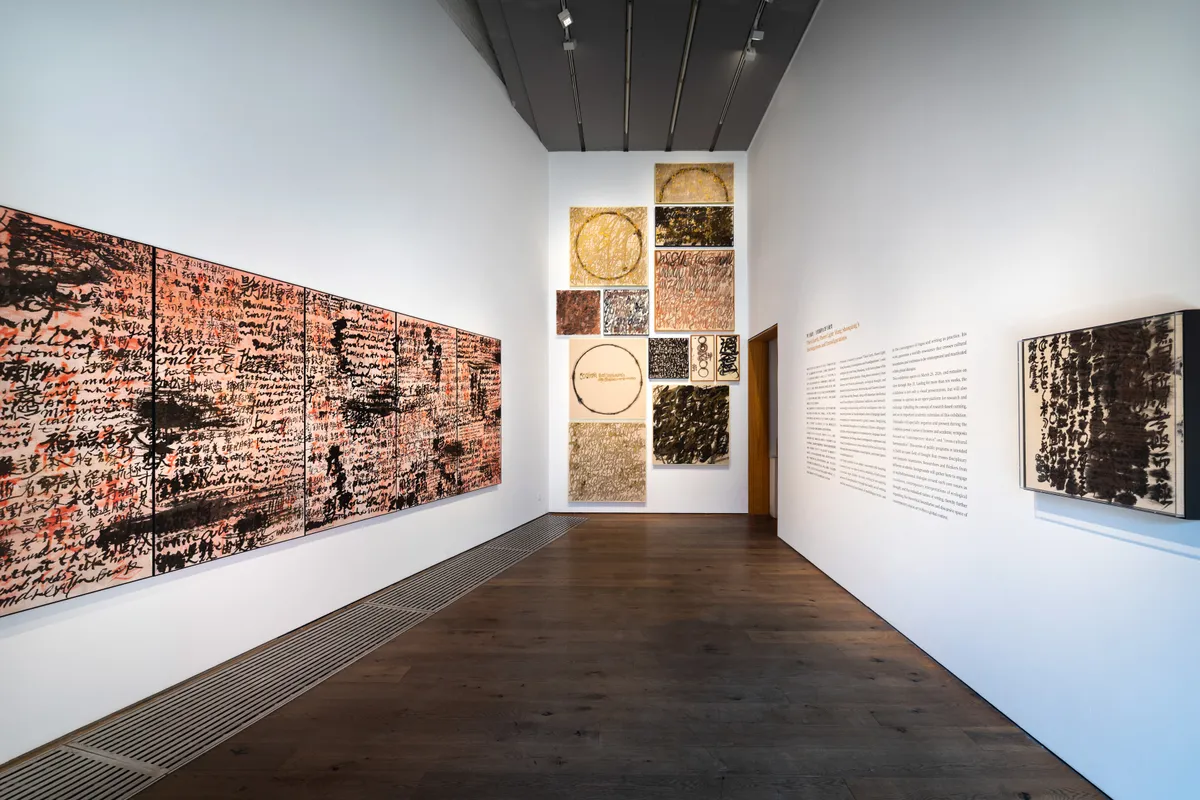
In the latest phase of his contemporary shuxie practice, Wang draws extensively from Eastern and Western philosophy, ecological thought, and historical textual resources. Referencing such Eastern classics as the Yijing and the Zhuangzi, along with important intellectual texts from different civilizational traditions, and forward-thinkingly incorporating artificial intelligence into his research process, he has developed a form of language-based conceptual art oriented toward a global context. Integrating the embodied discipline of traditional Chinese calligraphy with the critical perspective of contemporary language-based conceptual art, he brings about contemporary expression and visual reconfiguration of cross-cultural intellectual materials through the cross-translation, transcription, and reinscription of multilingual texts.
His works are held in the collections of numerous institutions, including the National Art Museum of China (Beijing); Guangdong Museum of Art (Guangzhou); Hubei Museum of Art (Wuhan); Zhejiang Art Museum (Hangzhou); Shandong Art Museum (Jinan); Guan Shanyue Art Museum (Shenzhen); Art Museum of Guangzhou Academy of Fine Arts (Guangzhou); Asia Art Center (Beijing / Shanghai / Taipei); He Xiangning Art Museum (Shenzhen); Suzhou Museum (Suzhou); Inner Mongolia Art Museum (Inner Mongolia); He Art Museum (Shunde); 33 Contemporary Art Center (Guangzhou); the Bernar Art Foundation (France); as well as important private collectors including Uli Sigg.